
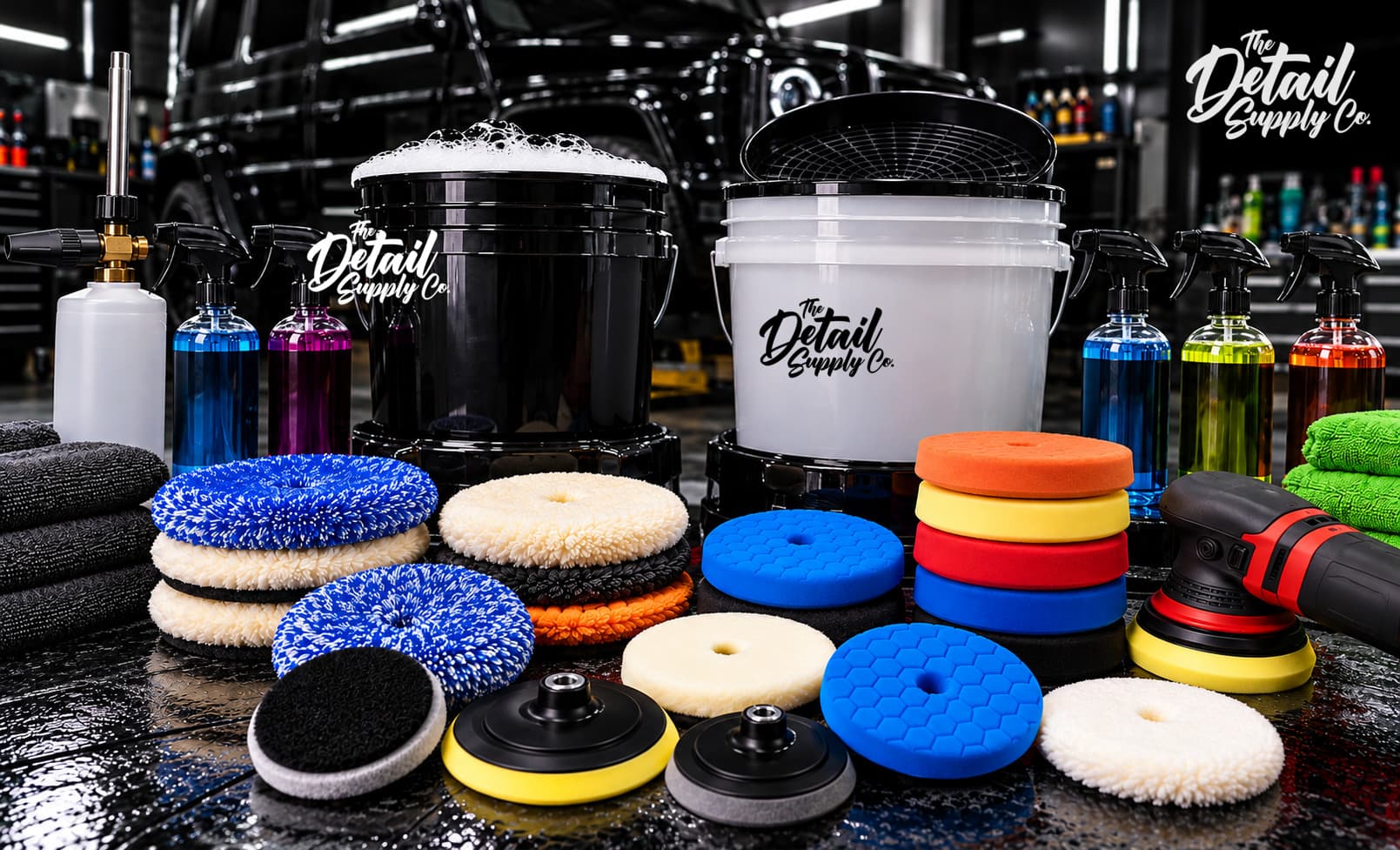
WOOL. HYBRID.
MICROFIBER. FOAM.
PICK THE RIGHT PAD.
Most people buy a better polish when the real problem is the pad. The pad decides how much cut you get, how much heat builds up, and how good the finish looks before the polish ever matters.
There are three core pad materials — foam, wool, and microfiber — plus hybrids that blend wool and foam to split the difference. Lake Country, the brand behind most of the pads we stock, builds its entire lineup around one idea: the right material directs heat and abrasion for the job in front of you. The wrong one does more harm than good, no matter how good the polish in the bottle is.
This is the no-nonsense version: what each pad actually is, when to reach for it, and where people get it wrong.
3
core pad materials every detailer should know: foam, wool, microfiber
40-50µm
typical clear coat thickness you're correcting — the wrong pad removes it fast
$58.1B
projected size of the global car detailing market by 2030 (Grand View Research)
Wool cuts hardest. Foam finishes cleanest. Everything else sits in between.
Lake Country's own polishing pad FAQ puts it plainly: wool pads are more aggressive than microfiber, and microfiber is more aggressive than foam — though the most aggressive microfiber and softest wool pads overlap in the middle. Here's that scale, start to finish:
Relative cut aggressiveness — not a lab measurement, a working scale based on Lake Country's own pad guidance and real-world comparisons.
Five pads.
Five jobs.

Foam — the all-rounder
Foam pads come in two builds. Reticulated (open-cell) foam is softer, breathes better, and runs cooler on long-throw DA polishers — Lake Country's own material science notes it increases durability and reduces heat buildup. Non-reticulated (closed-cell) foam holds product on the surface longer instead of absorbing it, which extends working time. Color-coded by firmness, foam covers everything from heavy cutting to final finishing, and it's the safest starting point if you're not sure which pad a panel needs.
2
foam types: open-cell (cooler, more durable) vs closed-cell (holds product longer)

Wool — the heavy hitter
Natural wool and lambswool fibers cut more aggressively than foam or microfiber on deep oxidation, heavy swirl, and show-car-level corrections. The open loft structure sheds heat fast, which is why wool survives high-speed rotary work that would cook a closed foam pad. The tradeoff is finish quality — wool leaves a hazier surface that almost always needs a foam polishing step behind it. It's a correction tool, not a finishing tool.
1st
pad material used on paint since machine polishing began — still the fastest cut available

Hybrid wool — cut and finish in one pad
Hybrid wool blends synthetic wool fibers with a foam face. Lake Country describes its hybrid wool pads as removing scratches as aggressively as natural wool while finishing closer to a foam pad — fewer pad changes mid-job, which matters when you're billing hours. It's the pad most DIYers reach for once they graduate past straight foam, because it forgives a little more heat and pressure than pure wool while still cutting hard enough to matter.
2-in-1
cuts like wool, finishes closer to foam — fewer pad swaps per job

Microfiber — the fastest cut, with a catch
Microfiber cutting pads remove defects nearly as fast as wool, which makes them a favorite for neglected paint, fleet work, and RVs where speed matters more than a mirror finish. The catch: microfiber runs hotter than foam and almost always leaves its own fine marring behind, so a foam finishing pass afterward isn't optional — it's part of the process. Skip it and the "correction" just swaps one set of scratches for a finer one.
+1
mandatory foam finishing pass after every microfiber cutting step

Microfiber all-in-one — the one-pad shortcut
All-in-one microfiber pads like Buff & Shine's Uro-Fiber blend two fiber grades — a lower-pile cutting fiber and a finer polishing fiber — into a single pad. The idea is to cut, polish, and finish without swapping pads mid-job, which is why maintenance details and lighter correction work lean on these. It won't out-cut a dedicated microfiber cutting pad on heavy defects, and you still need a clean pad per step even though it's technically "one pad" — but for a quick single-stage correction, it's the fastest path from swirled to clean.
2-in-1
fiber blend built to cut and finish without a pad swap on lighter jobs
Five rules that save
your correction.
One of each, covers every job.

Lake Country Prewashed Low Lint Lambswool

Lake Country Blue Hybrid Wool

Lake Country Microfiber Cut HDO

Lake Country Orange HDO

Lake Country Black HDO CCS
The bottom line.
There's no single "best" pad — only the right pad for the paint in front of you. Wool and hybrid wool for heavy correction. Microfiber when speed matters more than a perfect finish, followed by foam to clean it up. Foam alone for everything in between and every final pass. Build a small kit that covers all four and you'll rarely reach for the wrong one.
The polish gets the credit. The pad does the work.