
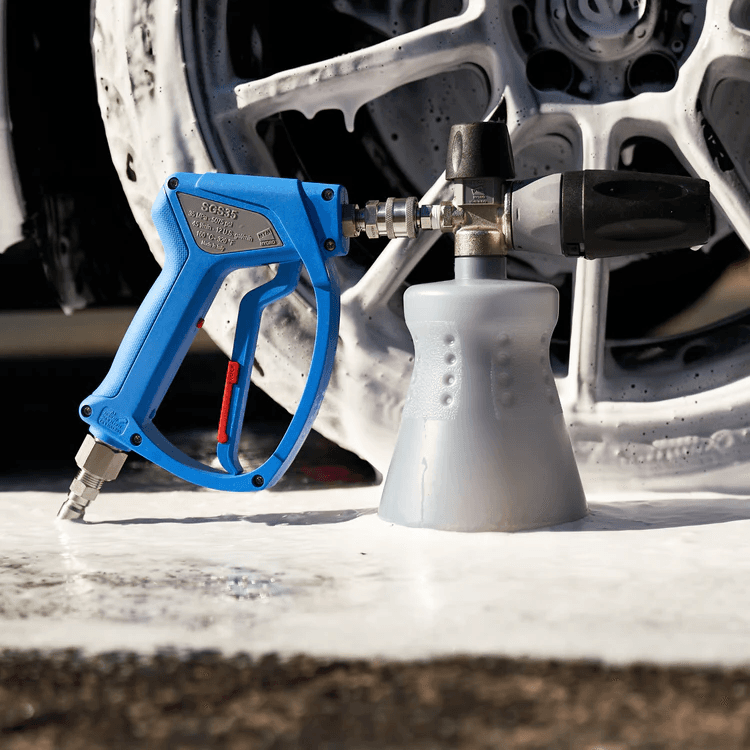
THE 0.4MM DIFFERENCE BETWEEN THICK FOAM AND A WET WASTE OF TIME
Most foam cannon problems trace back to one part nobody thinks about: the orifice. Here's what it actually does, and how to size it to your pressure washer's PSI and GPM instead of guessing.
Watery output. No soap draw. A half-hearted lather that rinses off before you can even look at it. Not the dial on top. Not the nozzle angle. The tiny machined restriction buried inside the cannon body.
If you've ever bought a quality foam cannon and gotten disappointing results, there's a real chance the orifice it shipped with wasn't matched to your pressure washer. Here's what you need to know to fix that.
A precisely machined restriction, measured in millimeters.
The orifice is a small brass or stainless insert with a calibrated through-hole, seated inside the foam cannon's body at the point where pressurized water passes through before entering the mixing chamber. Depending on the cannon, it's accessible near the quick-connect fitting or requires partial disassembly to swap.
Common sizes on quality cannons range from roughly 1.1mm on the small end to 1.5mm or larger on the high end, with 1.25mm and 1.35mm as frequent mid-range options. That tiny difference has an outsized effect on performance, because the orifice is the physical mechanism through which foam is created in the first place.
The Full Range
Typical spread between the smallest (1.1mm) and largest (1.5mm) common foam cannon orifice sizes
A foam cannon is a venturi-based aspirator, not a mixing device.
When high-pressure water is forced through the narrow orifice, it accelerates sharply — a fluid passing through a restriction has to speed up. That acceleration causes a drop in local static pressure at the restriction point. Higher velocity, lower pressure. That's the Bernoulli/venturi effect, and it's the entire engine behind your foam cannon.
That low-pressure zone pulls soap upward through the pickup tube. Because the pressure there is lower than atmospheric pressure acting on the soap in the bottle, the soap gets drawn into the water stream — no pump, no motor, just a pressure differential doing the work. After the soap and water combine, the mixture passes through a foam mesh before exiting through the nozzle, which is what creates texture and turns the liquid into cling-worthy foam.
The dial on top controls the blend. The orifice determines whether there's enough draw to make that dial mean anything at all.
“Stop diagnosing foam cannon problems at the dial. That's the last adjustment, not the first.”
— The Detail Supply Co
PSI alone is the wrong way to size an orifice.
PSI
Pressure — the force per unit area the pump generates. Higher upstream pressure means more acceleration through the restriction and a lower downstream static pressure, meaning stronger soap draw.
GPM
Flow rate — how much water volume moves through the system per minute. An orifice too large for the available GPM won't create enough velocity — or pressure drop — to draw soap at all.
A 1,500 PSI electric washer pushing 1.2 GPM and a 3,000 PSI gas unit pushing 2.5 GPM are fundamentally different fluid systems. The same orifice can't serve both optimally. Electric washers (roughly 1,300–2,000 PSI, 1.0–1.5 GPM) have less absolute flow — a smaller orifice, typically 1.1mm, maintains the velocity restriction needed for adequate venturi draw. Drop in a 1.5mm orifice on a 1,500 PSI electric unit and the pressure differential collapses; foam comes out thin and watery.
Gas pressure washers in the residential-to-prosumer range (roughly 2,600–3,200 PSI, 2.0–2.8 GPM) carry much more flow volume and can sustain strong draw through a larger orifice — 1.3mm to 1.5mm — which also allows higher total output and richer foam application. High-output pro gas units above 3,000 PSI and 3.0+ GPM can typically run 1.5mm orifices without issue.
A general guideline — not a spec sheet.
Optimal sizing varies by cannon model, soap dilution, and desired foam density. Always verify what size orifice your cannon actually shipped with before assuming.
| Pressure Washer Type | PSI Range | GPM Range | Starting Orifice |
|---|---|---|---|
| Light consumer electric | 1,300–1,800 PSI | 1.0–1.3 GPM | 1.1mm |
| Mid consumer electric | 1,800–2,300 PSI | 1.2–1.6 GPM | 1.1–1.25mm |
| Light residential gas | 2,500–2,800 PSI | 1.8–2.3 GPM | 1.25mm |
| Residential-pro gas | 2,800–3,200 PSI | 2.3–2.5 GPM | 1.25–1.35mm |
| Prosumer / pro gas | 3,200–3,700 PSI | 2.5–3.0 GPM | 1.35–1.5mm |
| High-flow pro gas | 3,500+ PSI | 3.0+ GPM | 1.5mm+ |
▲ Too Large for Your PSI/GPM
The more common problem on electric washers or lower-output gas units.
- — Foam is thin, watery, more like a soap rinse than a blanket
- — The dial makes little difference regardless of setting
- — Soap bottle level barely drops (poor chemical draw)
- — Foam slides off paint instead of clinging
Fix: swap to a smaller orifice. Dropping a 1.5mm to 1.1mm on an 1,800 PSI electric washer usually transforms output immediately.
▼ Too Small for Your PSI/GPM
Less common — happens with a high-output gas unit or an electric-spec cannon paired with a gas washer.
- — Foam is thick and dense but overall output volume feels low
- — A straining or restricted sound from the cannon
- — Soap bottle depletes unusually fast — over-drawing
- — Output pulses or sputters instead of a full fan
Fix: size up. A 1.35mm or 1.5mm insert with 2,500+ PSI / 2.5+ GPM gives you density without choking flow.
The Bottom Line
Fix the orifice first. Everything else is tuning, not the foundation.
On an electric washer, 1.1mm is almost always the answer. On a residential gas unit in the 2,800–3,200 PSI range, 1.25–1.35mm gives thick, cling-worthy foam without starving the cannon. Soap type, dilution ratio, and water temperature all matter too — but none of it compensates for a mismatched orifice.


