
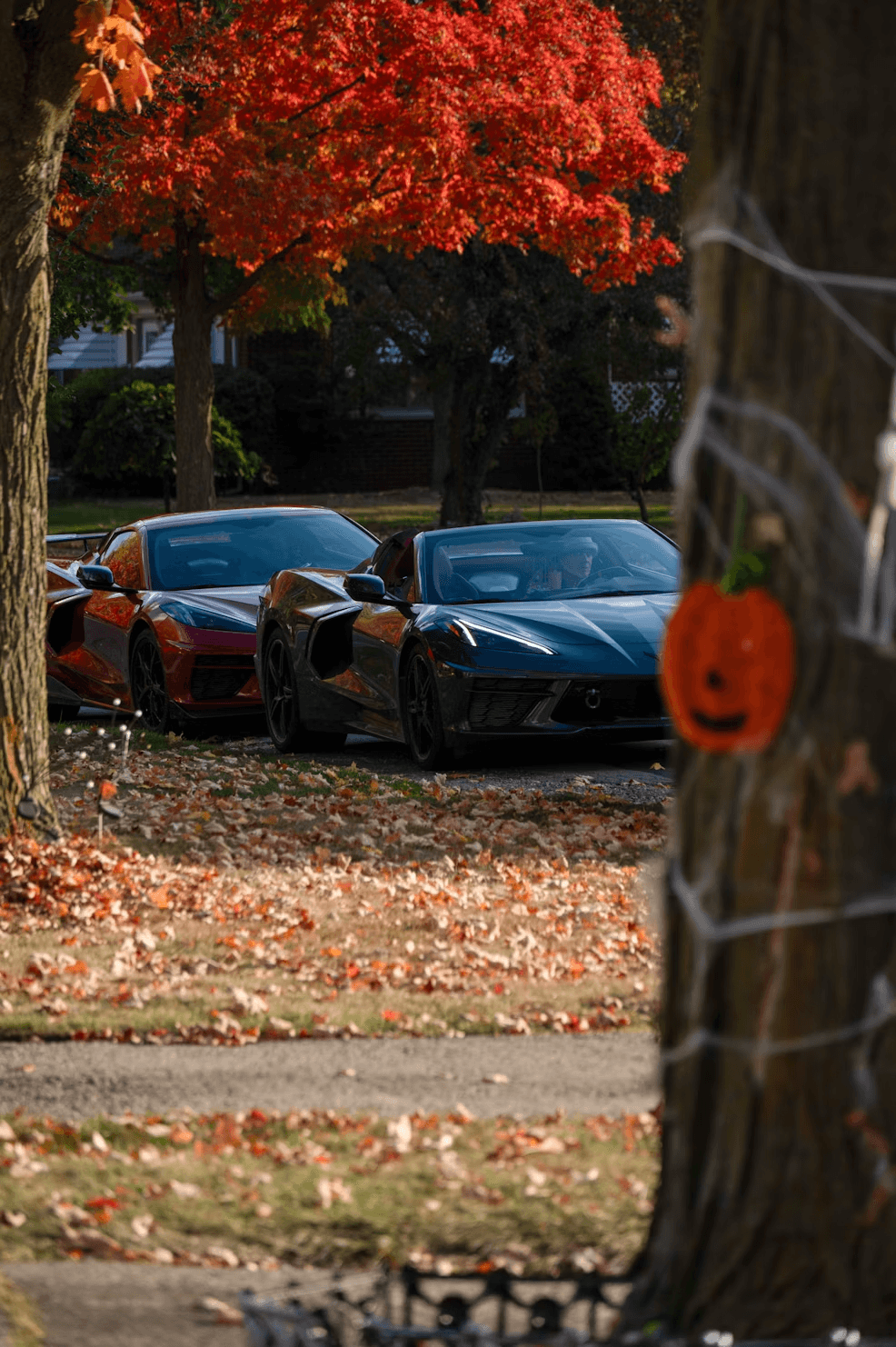
FALL DOESN'T CARE
ABOUT YOUR
CLEAR COAT
Tree sap is polymerizing on your hood. Tannic acid from decomposing leaves is etching your clear coat. UV accumulation from the entire summer is running out the clock. Fall is peak contamination season — and most people won't notice until the damage is already irreversible.
Here's what fall is actually doing to your paint — while you're busy watching the leaves turn.
Most car owners treat fall as a low-risk season. Summer's heat is gone. Road salt hasn't started yet. So the car sits — parked under oak trees collecting sap drips, blanketed in late-season pollen, absorbing the tail end of a summer's worth of UV exposure. The weather feels mild. The paint looks fine from ten feet away. Then November hits, the cold rain arrives, and suddenly the finish looks dull, rough, and hazy. The damage happened in October. You just didn't see it coming.
The chemistry of fall is more aggressive than most people realize. As leaves decompose on and around your car, they release tannic acid — a naturally occurring compound with a pH low enough to etch into clear coat. Tree sap, which is still dropping well into October across most of the country, undergoes polymerization as temperatures fluctuate: it hardens, bonds to the paint surface at a molecular level, and becomes exponentially harder to remove with each passing day. Meanwhile, UV radiation doesn't stop being destructive just because summer is technically over. Ambient UV is present year-round, and the accumulated photodegradation from April through September leaves your clear coat's polymer structure increasingly brittle and vulnerable to every other contaminant that's now landing on it.
Unlike road salt — which you can rinse off the undercarriage in February and largely undo — fall contamination is cumulative and largely invisible until it's permanent. A clay bar session and a protection layer now takes 45 minutes. Ignoring it and paying for paint correction in the spring takes 45 hours and costs between $500 and $2,800. This is the math. Here's the data behind it.
Time to Clear Coat Etching
Leaves begin damaging automotive paint within 24–48 hours of contact when moisture is involved — Select Car Leasing / SAE data
Paint Hardness Reduction
Tannic acid from decomposing leaves can degrade clear coat hardness by up to 50% over time — Society of Automotive Engineers research
Paint Correction Cost
Upper range for professional paint correction from environmental contamination damage — industry standard figures
Every contaminant attacking your paint this season — ranked by severity.
Severity index (0–100) based on pH chemistry, bonding mechanics, and time-to-permanent-damage — compiled from SAE technical data, Select Car Leasing research, and industry detailing publications
Bird droppings rank highest because of their combination of high acidity (pH 3.5–4.5) and rapid bonding — they can etch through unprotected clear coat in under 12 hours in warm conditions. Tree sap follows close behind: the longer it sits, the more it polymerizes and the more aggressive the removal process needs to be. UV radiation and tannic acid work more slowly but produce structural damage at the polymer level that can't be reversed without machine correction. Pollen and acid rain are often dismissed as minor nuisances, but extended seasonal exposure creates embedded staining and micro-etching that registers as permanent surface roughness — something a standard wash will never touch.
“A clay bar session now takes 45 minutes. A paint correction job in spring takes 45 hours — and costs up to $2,800.”
— The Detail Supply Co
Clear Coat Thickness Lost
UV radiation degrades up to 30% of your clear coat's 18–25 micron thickness — polymer bond breakdown causes hazing, fading, and brittleness
UV Blocked by Ceramics
Ceramic coatings block up to 95% of UV radiation, halting the photodegradation that makes fall and winter contamination exponentially more damaging
Resale Value Drop
Vehicles with visible paint damage — etching, fading, oxidation — lose up to 10% of their resale value (Kelley Blue Book)
A standard wash removes what's sitting on your paint. It doesn't touch what's already bonded to it.
This is the contamination gap most people don't know exists. After a full wash, run your bare hand across the hood. If it feels rough or gritty — like fine sandpaper under your palm — you have bonded contamination embedded in the clear coat. Soap and water don't remove it. A mitt can't lift it. It's in the surface, not on it. Tree sap undergoes polymerization as it dries, forming mechanical bonds with the clear coat matrix. Pollen particles embed in microscopic surface pores and oxidize over days and weeks, producing staining that regular washing actively redistributes rather than removes. Industrial fallout — iron particles from brake dust and rail dust — also accumulates on paint surfaces year-round and accelerates during fall when windows stay closed and cars sit idle longer.
A clay bar is the tool that addresses bonded contamination. It works through mild abrasive action against a lubricated surface — the clay medium grabs and pulls contaminants off the clear coat without scratching it, as long as proper lubricant is used. The result is a surface that's not just clean but physically smooth: a genuinely decontaminated paint surface. One bar handles roughly two full vehicles, depending on how contaminated the paint is. After claying, the surface should feel like glass under your hand. If it still has texture, you clay it again.
Claying is also the step that makes every protective product after it work properly. Wax, paint sealant, or ceramic coating applied over a contaminated surface bonds to the contamination, not to the paint. You get a fraction of the adhesion, a fraction of the protection, and a fraction of the durability. Decontaminate first. Protect second. In that order, every time.
The fall decontamination protocol is three steps and a weekend afternoon. Step one: pre-treat the worst deposits — tree sap, bug splatter, and hardened resin — with a dedicated bug and sap remover. Spray it on, let it dwell 30–60 seconds, rinse. This prevents you from dragging hardened organic material across your clear coat during the clay stage. Step two: wash the car properly and clay bar the entire exterior. Work panel by panel, lubricate heavily, and fold the clay bar frequently to expose clean medium. Step three: seal the decontaminated surface with a SiO2 ceramic spray or a quality wax. This is what buys you time through November and into December, when the real weather arrives and the contamination game gets even worse.
You don't need a garage, special equipment, or a professional appointment to do this right. You need the right products, 45 minutes, and the understanding that the contamination clock starts now — not when you finally notice the damage.
The Bottom Line
The oak tree doesn't care what your paint looks like. You should.
Sap bonds. Pollen oxidizes. Tannic acid etches. UV accelerates all of it. One decontamination session with a bug remover, clay bar, and a ceramic protection layer now is the difference between clean paint heading into winter and a paint correction bill in the spring. Here's what to reach for.


Sources
- Select Car Leasing — “Autumn Leaves & Car Paint Damage” — leaves begin damaging automotive paint within 24–48 hours of contact when moisture is present
- Society of Automotive Engineers (SAE) — Technical Papers on tannic acid degradation — tannic acid can degrade clear coat paint hardness by up to 50% over time
- thecarresource.com — “UV & Oxidation vs Clear Coat: Why It Loses 30% Thickness” — UV radiation degrades up to 30% of clear coat thickness (18–25 micron standard); ceramic coatings block up to 95% of UV rays
- Automaniacs.us — “Autumn's Silent Car Killer” — paint correction cost range ($500–$2,800); citing Kelley Blue Book on resale value impact (up to 10% reduction from visible paint damage)
- Hyperclean Store — “Environmental Contaminants Attacking Your Car Right Now” — biological contaminant bonding mechanics, pollen oxidation, UV degradation data
- Automotive Service Association (ASA) — Environmental and water damage repair cost ranges cited in seasonal vehicle damage reporting